I want people to leave LDM with useful skills, a clearer understanding of their decisions and a sensible way to keep developing. That starts with the person in front of us. Here’s how our courses, workshops, coaching, guiding and mentoring fit together, and what that approach means for you.
A good day in the mountains should be enjoyable. I also want it to leave you with something useful: a skill you understand more clearly, a decision you can explain, or an idea of what to work on next.
Practical teaching, appropriate challenges and support that makes sense for where you are now.
For one person, progress might mean planning their first independent mountain walk. For another, it might be climbing more comfortably, making better decisions on winter terrain or developing the judgement to lead other people.
Those are different goals. The way we help needs to reflect that.
Start with the person
Before deciding what a day should look like, we need to understand what you bring to it.
What have you done recently? What feels comfortable? Where do you tend to lose confidence or rely on someone else? What would you like to be able to do afterwards?
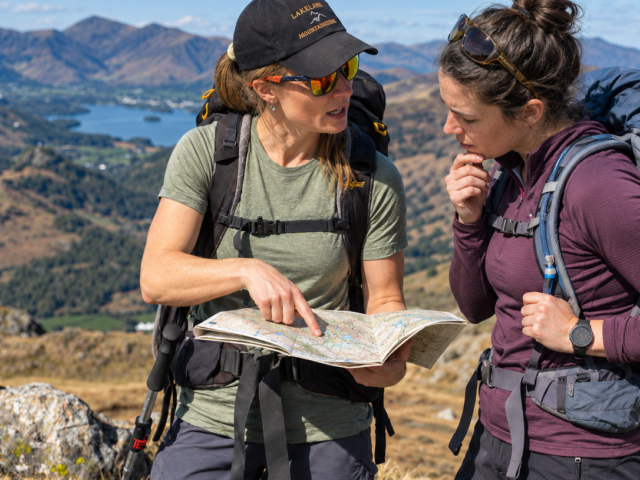
Experience can be uneven. You may have spent years in the mountains and want help with navigation. You may lead indoors but be new to trad climbing. You may have completed Mountain Leader training and need a clearer focus for your consolidation.
That information helps us choose the right starting point and agree something worthwhile to work towards. It also gives you space to ask questions without feeling you should already know the answer.
Make the learning practical
We want you involved in what you’re learning.
That might mean describing a navigation leg before setting off, explaining why you’ve chosen a piece of climbing equipment, or trying a movement task and noticing what changes.
There will be times for a clear demonstration and direct instruction. There will also be times to pause, ask a question or give you space to work something out. The approach should suit your experience, the task and the consequences of getting it wrong.
Learning a new skill takes attention. We choose the setting and challenge so there’s room for that learning to happen. Building familiarity on appropriate ground gives you something more reliable to carry into a bigger day.
Understand the decisions
Mountain skills involve making choices with incomplete information. A forecast helps us plan, but we still need to notice the conditions we find. A guidebook helps us choose a climb, but we need to judge whether it suits this team today.
I want the reasoning behind those choices to be part of the teaching.
Why this route? Why this pace? Why stop here to put another layer on? What would make us change the plan?
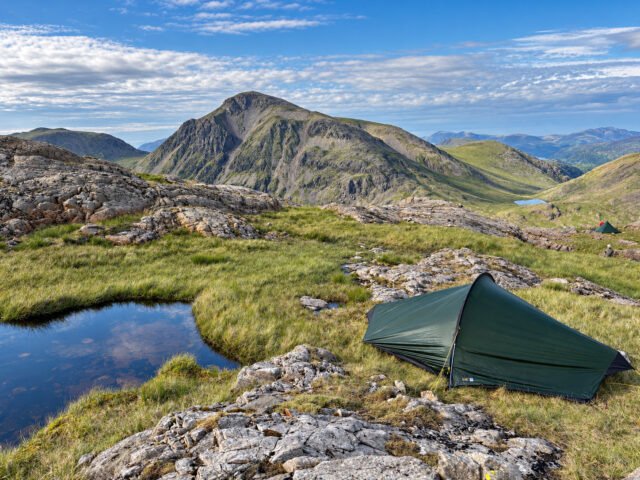
During a very wet and windy October week, I chose to camp low in Ennerdale and use the shelter available. That worked well for the conditions we had.
It’s a simple example of a decision responding to the situation. A camp choice still needs to account for the particular site, surrounding hazards, access and impact. The useful learning is understanding how those considerations come together.
Choose a worthwhile challenge
A challenge should help you develop something.
Sometimes that means a more demanding route. Sometimes it means repeating familiar ground while taking greater responsibility for navigation, improving a movement or making your communication clearer.
On a climbing day, a route below your limit might give you the attention to notice your footwork. On a mountain day, choosing a manageable objective might let you take the lead in planning and reviewing the route.
We can then look at what happened. Could you repeat it? What needed support? Would the skill still be dependable if the conditions changed?
Those questions help us judge when to build on the task and when more practice would be useful.
Give feedback you can use
Useful feedback should help you understand what to keep doing and what to change.
“Your navigation needs work” is too broad to guide much practice. Identifying that your plan lacked a clear description of the ground gives you something specific to improve.
We also want your view. What did you notice? What felt different on the second attempt? Was the task helping with the problem you wanted to address?
A short conversation can reveal whether the explanation made sense and whether the next task needs adjusting. That expectation applies to us as instructors too: reviewing our own teaching and being willing to change it.
Choose the support that fits
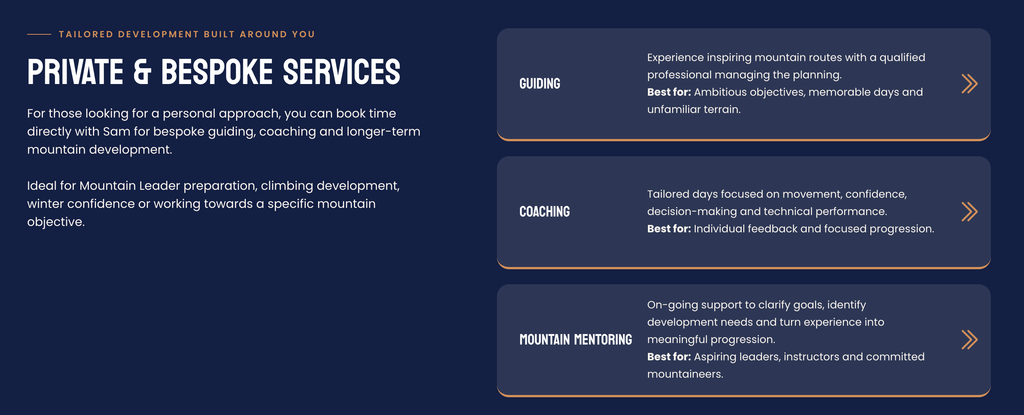
The different parts of LDM give us ways to respond to different needs.
| Support | When it can be useful |
| Courses | You want a structured introduction or development block, with time to bring related skills together. |
| Workshops | You have a particular subject to work on, such as navigation, movement, gear placements or belays. |
| Coaching | You want focused observation, tasks and feedback around how you perform and what is holding you back. |
| Guiding | You want professional support for a particular route or mountain experience, with learning included according to your aims. |
| Mentoring | You want an ongoing relationship to help you review experience, choose priorities and develop over time. |
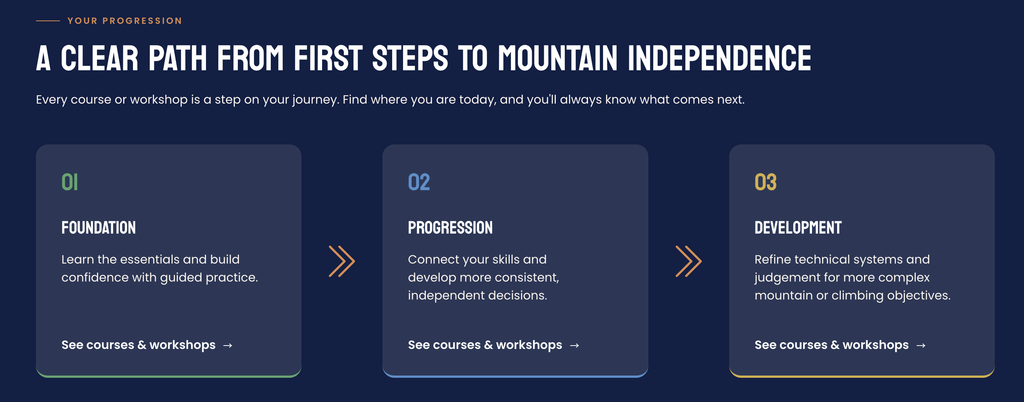
Foundation, Progression and Development help describe the personal-skills programme. They provide starting points for choosing suitable learning. Your experience and goals still matter when deciding what fits.
Leadership sits alongside that programme, supporting people taking responsibility for others. It involves a wider set of responsibilities as well as personal mountain skills.
You can use the parts that help you. Enjoying a guided day is a worthwhile aim in itself.
Take something into your next day
A useful course should leave you clearer about your strengths, what still needs work and what you can sensibly practise.
Choose a manageable task in an appropriate setting, with suitable support. Repeat it, review it and build on it when the evidence is there. Some skills need further supervised practice before you can use them independently.
Independence also includes recognising your limits, asking for help and choosing a different plan. Those decisions are part of taking responsibility.
The Knowledge Hub is here to support that process: practical articles, explanations and examples that help you prepare, reflect and keep learning.
If you’re unsure where to start, tell me about the days you already enjoy and what you’d like to feel more capable of doing. We can work from there.